
Facultad de Ciencias Químicas – UNC

Welcome to CERN, where science and discovery shape the future.
CERN is the European laboratory for particle physics and one of the world’s leading scientific research laboratories. CERN's business is pure research – physicists and engineers use the world's largest and most complex scientific instruments to study Nature's tiniest building blocks, the fundamental particles, to find out how our world and the Universe work. <br>An early European joint venture, CERN was founded in 1954 by the Conseil Européen pour la Recherche Nucléaire (hence the acronym). The Laboratory has become a prime example of international collaboration, with 24 Members States, seven Associate Member States, three Associate Member States in the pre-stage to Membership and a global community of more than 100 nationalities. <br><strong>CERN’s mission is to perform world-class research in fundamental physics and provide a unique range of particle accelerator facilities that enable that research to take place in an environmentally responsible and sustainable way. </strong>CERN also pushes the frontiers of science and technology for the benefit of society, trains new generations of physicists, engineers and technicians, and engages all citizens in research and in the values of science.
ACTIVITIES
We have a wide range of activities for all ages—come and get to know us!
Particle Detectives: A low-cost portable science show
Join us as ‘particle detectives’ to explore particles and their interactions, from molecules to CERN.
Gregory, M. (2024). Particle Detectives: A low-cost portable science show (Version 1). Zenodo. https://doi.org/10.5281/zenodo.10611185
The world is made up of particles. Here, we invite the audience to become “particle detectives” for the day, following along as we use a variety of interesting interactions to demonstrate the existence of particles and their interactions, zooming in from molecules to electrons, then to photons and some light explanations of how these all tie together in large particle detectors at CERN.
This show has been designed to be modular to allow maximum flexibility. Experiments can be switched in and out, depending on the level of the audience, available materials, and other local constraints. If followed as is, the main script should last approximately 40 minutes and is suitable for the general public or middle school / lower high school audiences.
An annex is included with a handful of other experiments, which can be added or substituted for a longer show, to adapt for older/younger audiences and if any of the main sequence experiments prove difficult to source materials for or to otherwise include.
This work was conducted in partnership with CERN Science Gateway and draws inspiration from their Science Shows, with all copyrights reserved by CERN.
All files can be downloaded from https://zenodo.org/records/10611185
Bubble Chamber
Dive into the fascinating world of bubble chambers and analyse tracks of high-energy particles with your students.
We have developed several activities for advanced high-school students, in which they study bubble chamber photographs and try to work out for themselves what they show. You can find a student worksheet describing these activities (including solutions and additional information for teachers) here: docx, pdf (version 12-03-2018)
Suggestions for educators
- Worksheet activity 1: How does a bubble chamber work? Students read a short text and learn about the different components of a bubble chamber.
- Worksheet activity 2: Electrically charged particles in magnetic fields. Students apply the right-hand-rule to identify tracks of positively and negatively charged particles due to their track’s curvature in magnetic fields.
- Worksheet activity 3: Particle identification and properties. Students learn to distinguish tracks of different particles (electrons, «Compton electrons», positrons, and protons) and calculate the momentum of a given particle track.
- Worksheet activity 4: Particle transformations. Students analyse the transformation of a pion.
- Watch a demonstration of a superheated liquid produced by microwaving pure water, which is too dangerous for the classroom.
- Watch a lecture by Don Glaser who won the 1960 Nobel Prize for Physics for his invention of the bubble chamber at Berkeley Lab. He discusses how, inspired by bubbles in a glass of beer, he invented the bubble chamber and detected cosmic-ray muons.
- Find out about recent dark matter detection experiments using bubble chambers from the PICO experiment website and the Fermilab website.
- Bubble chamber art: Bubble chamber patterns also look great as seasonal decorations (e.g., made using the technique of paper quilling) or on dresses. What other creative ideas can your students come up with?
- Online bubble chamber exercises: Find more advanced online exercises on Peter Watkins’s website.
Information text – about bubble chambers
Excerpt from Woithe, Schmidt & Naumann (2019)
From the 1920s to the 1950s, the primary technique used by particle physicists to observe and identify elementary particles was the cloud chamber. By revealing the tracks of electrically charged subatomic particles through a supercooled gas, with cameras used to capture the events, researchers could work out the particles’ mass, electric charge, and other characteristics, along with how they interacted. However, in 1952 the bubble chamber was invented, and this soon replaced the cloud chamber as the dominant particle detection technology. Bubble chambers could be made physically larger, and they were filled with a much denser material (liquid rather than gas), which made them better for studying high-energy particles.
Today, both cloud chambers and bubble chambers have largely been replaced by other types of detectors that produce digital signals and work at a much faster rate. So while photos from bubble chambers are no longer the technology of choice for professional physicists, they can still enrich the discussion of particle physics in the classroom.
How does a bubble chamber work?
The key component of a bubble chamber is a superheated liquid. When electrically charged particles pass through a bubble chamber, they ionise the molecules in the chamber medium. The ions trigger a phase transition and the superheated liquid vaporises, creating visible tracks as bubbles form along the particle’s path. Once the newly formed bubbles have grown large enough, cameras mounted around the chamber capture the event.
Importantly, a uniform magnetic field runs through the chamber, which produces a force on moving electrically charged particles, making them move in curved paths – and creating ‘signature’ shapes for different particles. Measuring the radius of curvature allows a particle’s momentum to be calculated, providing further clues to its characteristics.
Additional material
Read more about an easier version of this classroom activity in ‘Science in School’: Woithe, J., Schmidt, R., Naumann, F. (2019). Track inspection: how to spot subatomic particles, Science in School, 46
Where can I find bubble chamber photographs?
The images used the activity we propose were produced by the 2 m-long bubble chamber at CERN in 1972. This chamber was filled with 1150 litres of liquid hydrogen cooled to 26 K (–247°C). The bubble chamber was exposed to a beam of protons from CERN’s proton synchrotron PS with a momentum of 24 GeV/c.
Scans of the original photographs, as well as images with coloured tracks, can be found online: https://cds.cern.ch/record/2307419
ATLAS Magnet Model
The ATLAS detector, the largest particle detector at the LHC, is one of the most complex machines ever built. However, due to its complexity, explaining the ATLAS detector at a high-school level can be challenging. Below, we show how to use simple materials (straw and cardboard) or 3D printers to build a model of the toroidal ATLAS magnet system. We also suggest learning activities for the physics classroom.
3D-printable Laserlab
Space, time, and matter are among the most fundamental concepts we rely on for structuring our understanding of the surrounding world. In the past, fundamental research has made the most astonishing discoveries on the nature of these and has shown that our everyday understanding cannot be quite right.
Many times, advances in our understanding are closely tied to sophisticated experiments, which are, however, often not easily accessible to a broader public. Now, with the growing popularity of 3D printers, many of those experiments can indeed be conducted at home, on your very desk.
Scope of the project
In this line of reasoning, this project proposes a Do-it-yourself 3D printed Laserlab, which allows for hands-on experimentation in the realms of Special Relativity and General Relativity as well as Quantum Physics. Technically, the Laserlab consists of 3D-printed optical mounts that are complemented by inexpensive components such as screws, magnets, or mirrors. Once assembled, they serve as building bricks for experimental setups, very much like those you would find in a professional photonics laboratory (but for a fraction of the cost).
What you can build
At its heart, the Laserlab is a photonics lab that allows building various interferometry setups, such as a Michelson-Interferometer, a Mach-Zehnder Interferometer, or a Quantum Eraser.
Currently, three major experiments are proposed (but you are free to also devise your own):
- Special Relativity: Set up a Michelson-Interferometer and test the fundamental hypothesis of Special Relativity: the invariance of the speed of light. This idea is at the core of highly counterintuitive phenomena such as time dilation or length contraction.
- General Relativity: It’s only very recently that gravitational waves have been observed by gravitational wave detectors such as LIGO or Virgo. In essence, gravitational wave detectors are Michelson-Interferometers, which have been enhanced to greatly increase their sensitivity. Gravitational waves passing through these detectors will result in changing optical path lengths in the interferometer’s cavities and hence shifting interference patterns. The 3D printed Laserlab features a piezo-driven mirror that can be moved in the order of some 100 nanometers (ten-thousandth of a millimeter). This makes it possible to simulate the effect of gravitational waves and thus gain a better understanding of what is happening in large gravitational waves detectors.
- Quantum Physics: The Quantum World often seems very strange to the point of being barely comprehensible from a common-sense point of view. One of the stranger features is what happens during measurement and how the measurement itself affects what is being measured. A well-known experiment to explore the subtleties of Quantum Physics is the so-called “Quantum Eraser.” With the Laserlab, you can build one and explore the Quantum World for yourself.
Getting started
Explore!
Download the manual and the required .stl files.
Download the provided Arduino sketch.
Choose which experiment you would like to build.
3D print the mounts you’ll need according to the specifications in the manual.
Order screws, magnets, a steel base plate, and optical components from your favorite supplier.
Assemble the lab and set up the experiment.
EXHIBITIONS
Join us to explore the Universe at CERN. With hands-on experiments, real scientific objects, immersive environments and interactivity, the exhibitions at Science Gateway will bring CERN to life.
Try your hand at accelerating particles, explore how CERN’s giant experiments reveal the mysteries of matter. Take a trip through 13.8 billion years of the Universe to experience the voyage your particles took on their way to becoming you. Visit Quantum World to discover the weird and wonderful way the Universe works at the smallest of scales. An arts space on the theme of Exploring the Unknown hosts several new contemporary artworks inspired by the work of CERN scientists.
DIscover CERN
Accelerate: explore CERN’s particle accelerators
Scientists from all over the world join forces at CERN to answer profound questions about the Universe. Let them guide you through the laboratory!
An immersive scenography will transport you to the underground tunnels where the smallest building blocks of matter accelerate and collide. Discover machines of a remarkable scale and complexity.
The exhibitions are full of hands-on experiments for ages 8 and upwards. Play the control room game, pilot a robot and dig a tunnel. Explore the extraordinary technologies inside the Large Hadron Collider and, let’s see…will you score in a game of proton football?
Collide: find out how CERN studies particles
Beams of particles travel at almost the speed of light around the Large Hadron Collider, with billions colliding every second. Discover how the giant experiments record these particle collisions and how a global network of computers processes the data. Hear scientists’ stories about their work and find out how their technology can be used in hospitals. Use our headsets to take a virtual tour. Collaborate with other visitors to lower a piece of experiment underground. Design your own experiment to detect particles.
Age
Recommended for ages 8 and upwards.
Duration
We recommend you allow 1.5- 2 hours to visit our three exhibitions.
Languages
Screen text in 5 languages (French, English, German, Italian and Spanish).
Accessibility
Audio descriptions and tactile content, video subtitling. Pushchair and wheelchair accessible. More details.
Our Universe
Back to the Big Bang: the journey your particles took on their way to becoming you
Take a journey back 13.8 billion years, to the very beginning of time. Discover how the Universe evolved to become what we see around us today. Try out the experiments to find out how scientists do their investigations. Are you ready to get transported through the different stages of the Universe? Design your own star and eject it out into space, play with the proton weighing scales and try your hand at trapping antimatter.
This exhibition has low lighting levels. If you need to visit in higher lighting conditions, please consult the accessibility page for more information.
Exploring the unknown: a contemporary art space
There are still many mysteries in the Universe that scientists are seeking to answer. Discover how the artists in residence on the Arts at CERN programme were inspired by their exchanges with CERN scientists to explore topics such as the emptiness of space, the invisible and space and time. Amongst the original works on display are a constantly moving, 3-dimensional shadow of a 4-dimensional object!
Age
Recommended for ages 8 and upwards.
Duration
We recommend you allow 1.5- 2 hours to visit our three exhibitions.
Languages
Screen text in 5 languages (French, English, German, Italian and Spanish).
Accessibility
Audio descriptions and tactile content, video subtitling. Pushchair and wheelchair accessible. More details.
Quantum World
Explore how the Universe works at tiny scales
We live in a Quantum World! Quantum physics explains why the sun shines. It allows us to make smartphones and to understand how plants grow. Yet, strange and wonderful quantum effects only occur at the tiny scales of particles… don’t they? In this interactive exhibition discover the world of particles as if you yourself were so tiny.
A 20-minute guided interactive adventure gives groups of 8 a chance to experience quantum effects first hand. Departure every 8 minutes. Alongside, there are exhibits to explore – sing quantum karaoke, spot the entangled particles, play the quantum tunnelling game and try out quantum tennis. All is not as it might at first seem…
Age
Recommended for ages 8 and upwards.
Duration
We recommend you allow 1.5- 2 hours for visiting our three exhibitions
Languages
Screen text in 5 languages (French, English, German, Italian and Spanish).
Accessibility
Audio descriptions and tactile content, video subtitling. Pushchair and wheelchair accessible. More details.
TICKETS
Prices do not change on holidays or weekends.
| AGE | PRICE |
|---|---|
| <3 | 0$ |
| 3-18 | 10$ |
| 18-65 | 25$ |
| >65 | 0$ |
Please note that if you have a disability certificate, the price is $0.
OPENING HOURS
CERN Science Gateway is open from Tuesday to Sunday, closed on Monday
- Exhibitions and other activities from 09.00 to 17.00
- Last entry at 16.30
- Reception, Shop and Big Bang Café from 8.30 a.m. to 17.30
Exceptional closures
CERN Science Gateway will be exceptionally closed on the following days:
- Wednesday, 24 December 2025
- Thursday, 25 December 2025
- Wednesday, 31 December 2025
- Thursday, 1 January 2026
Reduced programme
There won’t be any guided tours on the following periods:
- From Friday, 19 December 2025 to Monday, 5 January 2026 inclusive
GETTING HERE
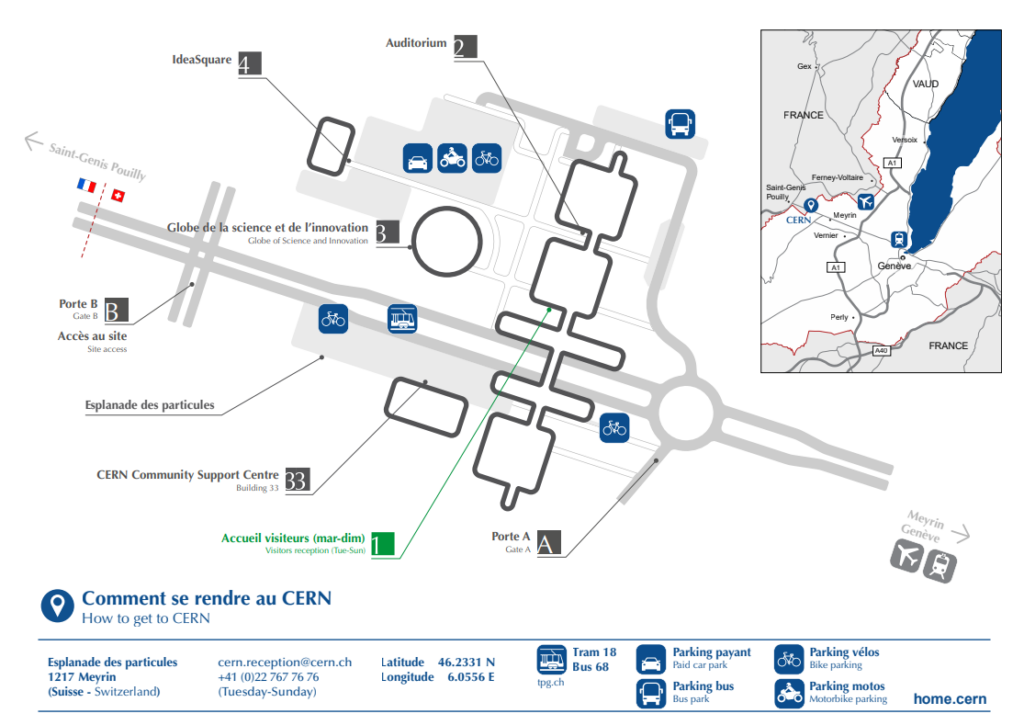
1, Esplanade des Particules
1217 Meyrin
Switzerland
Public transport
- Bus from France : take bus 68 or bus 67 (direction: Blandonnet). There is a bus stop at the entrance to CERN.
- Tram from Geneva : take tram 18 and get off at the last stop (”CERN»). If you are staying at a hotel in Geneva, it may offer free public transport cards.
Car
- A paid car park is located behind the Globe of Science and Innovation. Please note that parking is allowed only for the duration of your visit. Parking outside the car park is forbidden and vehicles parked illegally may be fined by local authorities.
- Click here for more information on parking rates and rules.
- If this car park is full, an alternative paid car park is available by the French customs at the Centre sportif de Maisonnex.
Coaches
- There is a free coach park north of the CERN Science Gateway. This park is reserved for coaches of groups with a booking. Smaller vehicles (cars, minibuses, vans, campers etc.) must be parked in the paid car park or may be fined by local authorities.


Hi, this is a comment.
To get started with moderating, editing, and deleting comments, please visit the Comments screen in the dashboard.
Commenter avatars come from Gravatar.